IsleCast
In DevCaribbean weather intelligence as a service. Wopnin's consensus engine, scaled to every island.
Status
In Development
Model
Multi-Tenant SaaS
Foundation
Wopnin Engine
Scope
Caribbean-Wide
islecast.live - scroll to explore
01
The Problem
Wopnin was built for Bermuda. But every Caribbean island has the same problem: weather data exists, but nobody is turning it into something useful for the people actually on the ground: residents, tourists, boat operators, event planners, hotel concierges.
Islands depend on tourism, and tourism depends on weather. Yet most Caribbean destinations still rely on generic global forecasts that treat every island the same. No local context. No activity recommendations. No beach conditions. No sense of what the weather actually means for someone planning their day.
Building a bespoke weather platform for each island does not scale. The development cost is too high and the population too small. What the Caribbean needs is a shared engine with per-island intelligence: a platform that can serve Barbados and Bermuda from the same codebase without either feeling like a clone of the other.
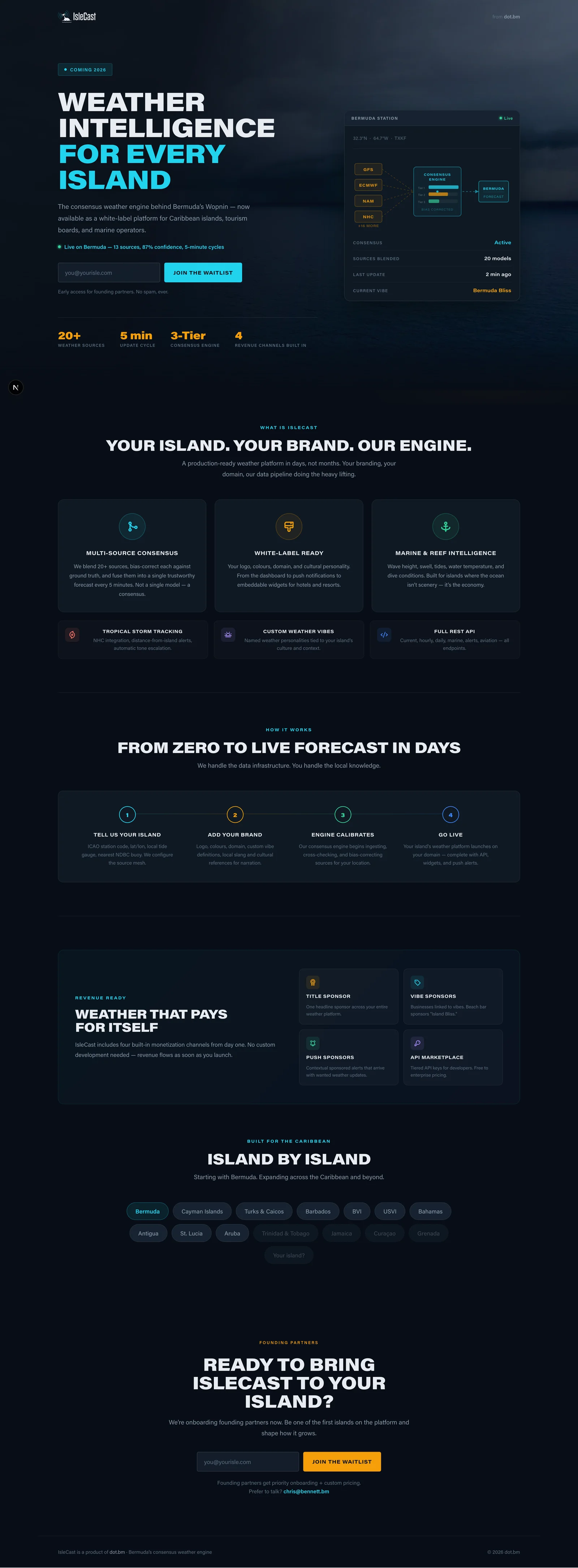
Full platform view: weather intelligence + tourist layer
02
The Approach
IsleCast takes Wopnin's three-tier consensus engine and packages it as a multi-tenant SaaS platform. Each island is a tenant with its own branding, vibe definitions, weather station configurations, and API keys. One engine, many islands, zero compromise on local accuracy.
The tourist intelligence layer is what sets it apart. Real-time weather data drives beach and reef condition reports, dive visibility estimates, activity scoring, daily planners, packing lists, dining recommendations, and water sports go/no-go calls. It is not a forecast page with a logo swap. It is a full product, localized down to the slang.
Each tenant gets a complete admin panel to manage their island's identity: branding and colour scheme, local content (beaches, landmarks, restaurants, dive sites), weather station mappings, and engine health monitoring. Tourism boards and hotel groups can white-label the entire experience under their own domain.
Technical stack: React frontend, Python consensus engine, Docker-based deployment, edge-based tenant resolution, multi-source weather data fusion, and a service worker layer for offline resilience in areas with spotty connectivity.
03
How It Works
Edge-based tenant resolution. Tenant resolution happens at the edge. Subdomains on islecast.live or custom domains map to a specific island's configuration. A request to bermuda.islecast.live loads Bermuda's branding, data sources, and local content. A request to barbados.islecast.live loads Barbados. The routing decision happens before the page even renders.
Consensus engine per island. Under the hood, it is the same consensus engine that powers Wopnin: the same source fusion, the same model disagreement resolution, the same authoritative output. But each island gets its own source configuration, its own station mappings, its own calibration. The engine adapts to what is available per geography.
Revenue model. IsleCast monetizes through per-island SaaS subscriptions for tourism boards and hospitality groups, white-label licensing for hotel and resort chains, sponsored content and activity recommendations, and an API tier for developers building on Caribbean weather data.
04
The Result
IsleCast turns a single-island product into a Caribbean-wide platform without losing what made Wopnin work: accuracy, personality, and local relevance. Every island gets a weather product that feels like it was built just for them, because the engine beneath it was built to make that possible.
The consensus engine has already proven itself in production on Bermuda through Wopnin. IsleCast is the path from one island to every island, with a business model that scales alongside it.
For the Caribbean, it means weather intelligence stops being something only well-funded destinations can afford. For dot.bm, it means the hardest technical work, building a consensus engine that actually works, only had to be done once.